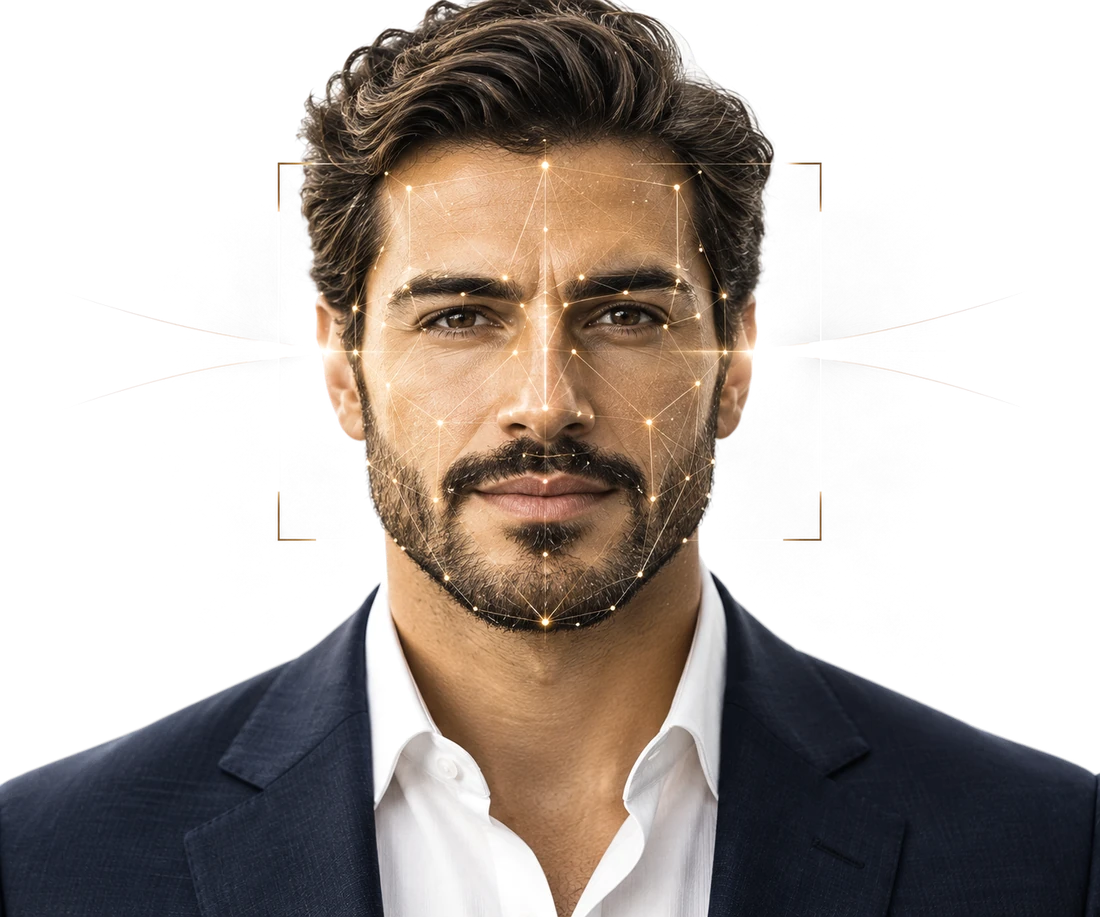
Privacy-Preserving Biometrics
Privacy-preserving biometric authentication that never exposes or stores biometric templates. Multi-factor authentication with genuine identity assurance in a single action.
Learn moreConnecting Experiences
It is the discipline of uncovering value at new frontiers, redesigning every customer journey around personalized, contextual, real-time automated interactions, and building the mindsets and architecture that let an organization move fast. Every one of those interactions depends on one question: who is on the other side?
No security, no digital.
With mission-critical systems at stake, high-value transactions moving online, fraud and deepfakes on the rise, regulators pushing harder, and customers expecting effortless experiences, every business faces the same test: can you deliver your service with certainty, and manage the risk well enough to recreate the experience of meeting your customer in person?
Identity & security solutions
Cybersecurity consulting, privacy-preserving biometric authentication, decentralized identity, and post-quantum protection for banking, government, and telecommunications across MENA.
Privacy-preserving biometric authentication that never exposes or stores biometric templates. Multi-factor authentication with genuine identity assurance in a single action.
Learn moreNIST-aligned, mobile-first authentication with hybrid cryptography protecting your infrastructure against quantum-era threats today.
Learn moreThe problem
Authentication still rests on stand-ins. A username and password are treated as proof of who you are. An SMS code or an MFA app is treated as proof of the device you hold. Each has been routinely defeated: passwords are phished, SMS codes are intercepted or redirected through SIM swaps, and MFA prompts are pushed until someone approves.
Passwords, one-time codes and voice checks prove only that someone knew, received or sounded like something. Each one can be phished, intercepted or faked.
Identity-verification systems store face data in honeypots exposed to deepfakes, and forget the person once onboarding ends. Device biometrics fall back to a PIN, so they prove the phone was unlocked, not who unlocked it.
They rely on device biometrics, so a PIN can stand in for the person, and nothing ties the key to a verified identity.
Without a binding proof of who approved each transaction, there is no accountability.
None of these methods can prove that the person authenticating is the same person who enrolled.
How the Unified Identity Assurance Platform closes the gapThe value
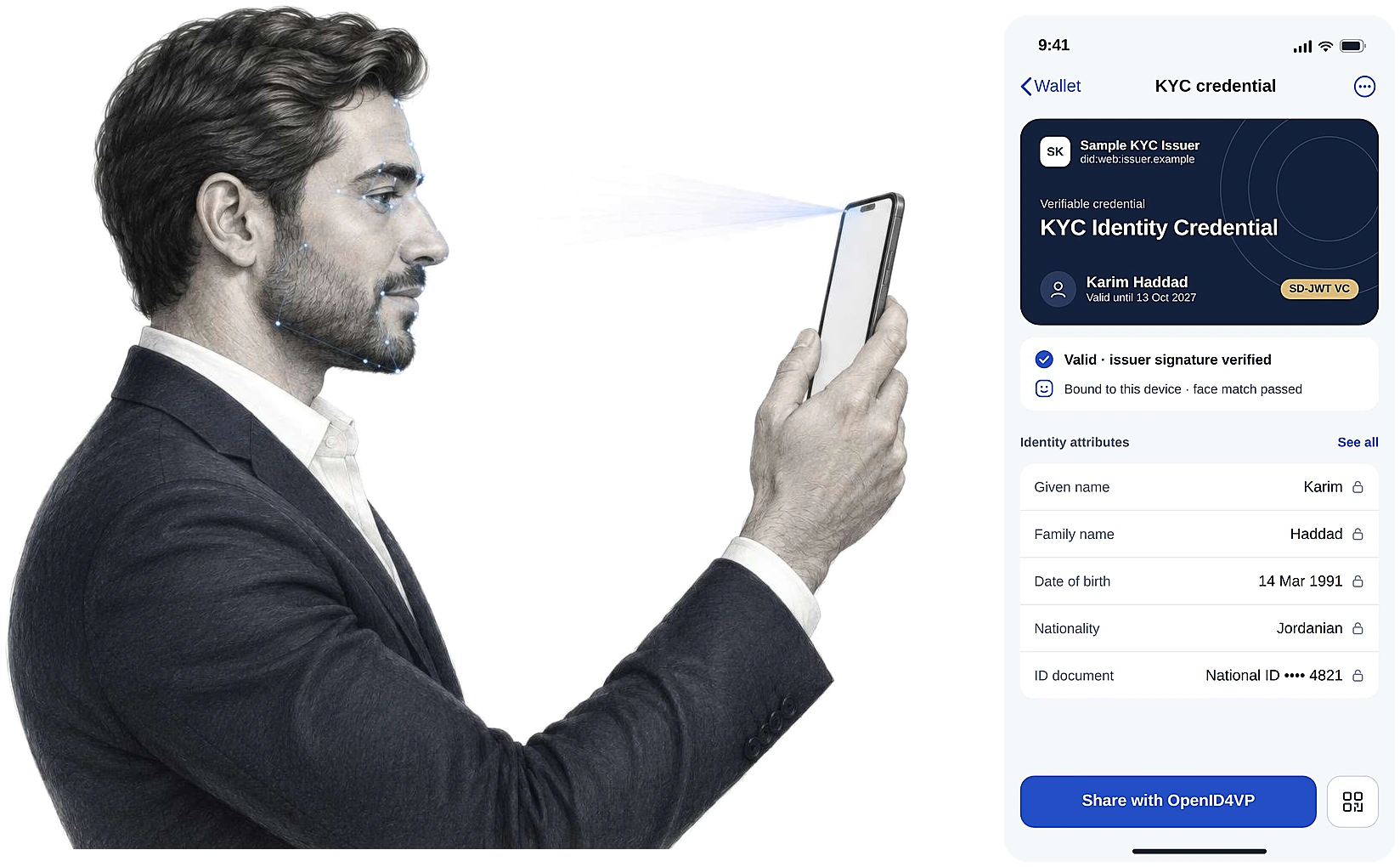
Verifiable credentials change the model. With zero-knowledge proofs, a customer proves a fact, such as “over 18” or “identity verified”, and reveals nothing beyond that fact. Every credential is digitally signed by its issuer, so any alteration is instantly detectable. Each time it is presented, it is bound to three things at once: the holder's own face, matched without storing a biometric template; a key that never leaves the holder's device; and the KYC record it was issued from.
Privacy-preserving biometrics confirm that the person acting is the person who enrolled, without any biometric data being stored on the device or the server.
Each transaction is cryptographically signed and tied to the person, their device, the app, and the exact amount and payee. Consent can't be denied, and signatures stand up in disputes.
No passwords or codes to phish, no templates to breach, and a post-quantum-ready design that leaves nothing worth harvesting.
A single step delivers true multi-factor assurance, and self-service recovery uses the customer's face, with no call centre and no SMS codes.
Deployed in your own infrastructure, so customer data, server-side keys and audit records stay within your environment and your governance.
Every figure we publish traces to a primary source, listed below.
Platform
The SMS OTP successor. Consent-based biometric verification for telecom operators, banks, and government.
Transform KYC into revenue. Turn regulatory KYC compliance into a revenue-generating identity-as-a-service platform, with configurable fee structures per service type: basic authentication, identity verification, full KYC, and age attestation.
PSD2/PSD3 transaction signing. Dynamic linking with genuine identity assurance. Replace SMS OTP with consent-based biometric verification.
Zero-knowledge architecture: OID4VC, W3C VC 2.0, BBS+, FIDO2/WebAuthn, silent SIM verification, post-quantum ready.
Eleven revenue streams, from age verification and call center authentication to money wallet compliance and borderless identity-as-a-service.
Technology foundation
Verifiable credentials are becoming the unifying framework for digital identity. Zero-knowledge proofs provide the privacy layer. Biometric binding provides the assurance layer.
// Illustrative selective-disclosure presentation
{
  "issuer":  "Telecom operator (KYC)",
  "holder":  "Customer wallet",
  "claims": {
    "age_over_18": true,
    "birthdate":   "••••-••-••",
    "national_id": "••••••••••"
  },
  "holder_binding": "privacy-preserving biometric",
  "proof":   "BBS+ / SD-JWT"
}
How we work
Digital transformation is not a destination, it is a discipline: understand the problem deeply, define the purpose clearly, then apply the right technology to create measurable value.
Problem mapping, stakeholder alignment, current-state assessment, opportunity sizing.
Value architecture, technology roadmap, regulatory alignment, business case development.
Solution deployment, integration, testing, change management, knowledge transfer.
Performance measurement, continuous improvement, capability building, scale planning.
Let's discuss how Imagineers can strengthen your organization's security posture and identity infrastructure.
Ibn Zuriek St., Jubaiha
Amman, Jordan
Sunday to Thursday, 9:00 AM – 5:00 PM (GMT+3)